A Design Award for Airflow: What It Means for Your Compressor Room
A design award for something nobody looks at
Dürr Dental's redesigned Tornado compressor won a German Design Award 2026 in the "Excellent Product Design" category. The jury's stated reasoning: "The compressor and hood feature a distinctive design that distinguishes the NEW Tornado as a quality product," and that "its inherent advantages — both technological and practical — are thus adequately reflected in its exterior appearance."
That's an unusual thing to win a design prize for. Nobody in the practice looks at the compressor. It sits in a utility room, usually behind a door nobody opens except for service visits. But the specific change behind the award is worth a closer look, because it points at a maintenance problem every practice with a compressor already has, whether the unit is new or fifteen years old.
Airflow, not looks, is what changed
According to Dürr Dental's own announcement, the redesign centres on the air ducting: "The flow design of the air ducting ensures more efficient heat dissipation and protects critical components from heat stress." A soundproof hood is also available as an option "for particularly quiet operation when installed in treatment rooms."
Both changes respond to the same underlying issue: heat. Independent maintenance guidance for dental compressors is consistent on this point — a sustained motor-temperature rise of 10–15°C above the room's ambient temperature is treated as a warning sign, and the most common cause cited is poor ventilation from installing the unit in a cramped, enclosed space. A layer of dust on the cooling fins acts as an insulator that traps heat further, which is why keeping the fins and motor housing clean is listed as routine maintenance rather than an optional extra.
Put simply: a compressor that runs hot fails sooner. A redesign that moves air around the components more efficiently, or a room that gives an older unit the clearance to do the same, is solving the identical problem from two different ends.
The maintenance rhythm most practices only half-follow
None of this needs new equipment to fix. Maintenance guidance for dental air compressors converges on a similar rhythm regardless of brand:
- Daily — drain the tank (twice a day in humid climates) until only air escapes, and watch for pressure drops between cycles beyond roughly 0.2–0.3 bar, which usually signals a leak.
- Weekly — check the air intake filter for dirt and test the automatic drain valve if the unit has one.
- Monthly or by operating hours — replace coalescing/particulate filters every 3–6 months depending on duty cycle; on oil-lubricated units, change the oil every 1,000–2,000 hours, sooner if it looks dark or milky.
- Annually — one manufacturer's own maintenance schedule for its dental compressor line calls for replacing air filters and the filter element, inspecting the dryer, and testing the safety valve once a year or when a maintenance indicator activates, with desiccant cartridges replaced every five years or 10,000 hours.
Most of that is a five-minute checklist, but it's also the first thing that gets skipped when the schedule is full. A hot, dirty, or under-drained compressor doesn't announce itself until pressure drops mid-procedure.
Why this belongs in the same conversation as barrier sleeves
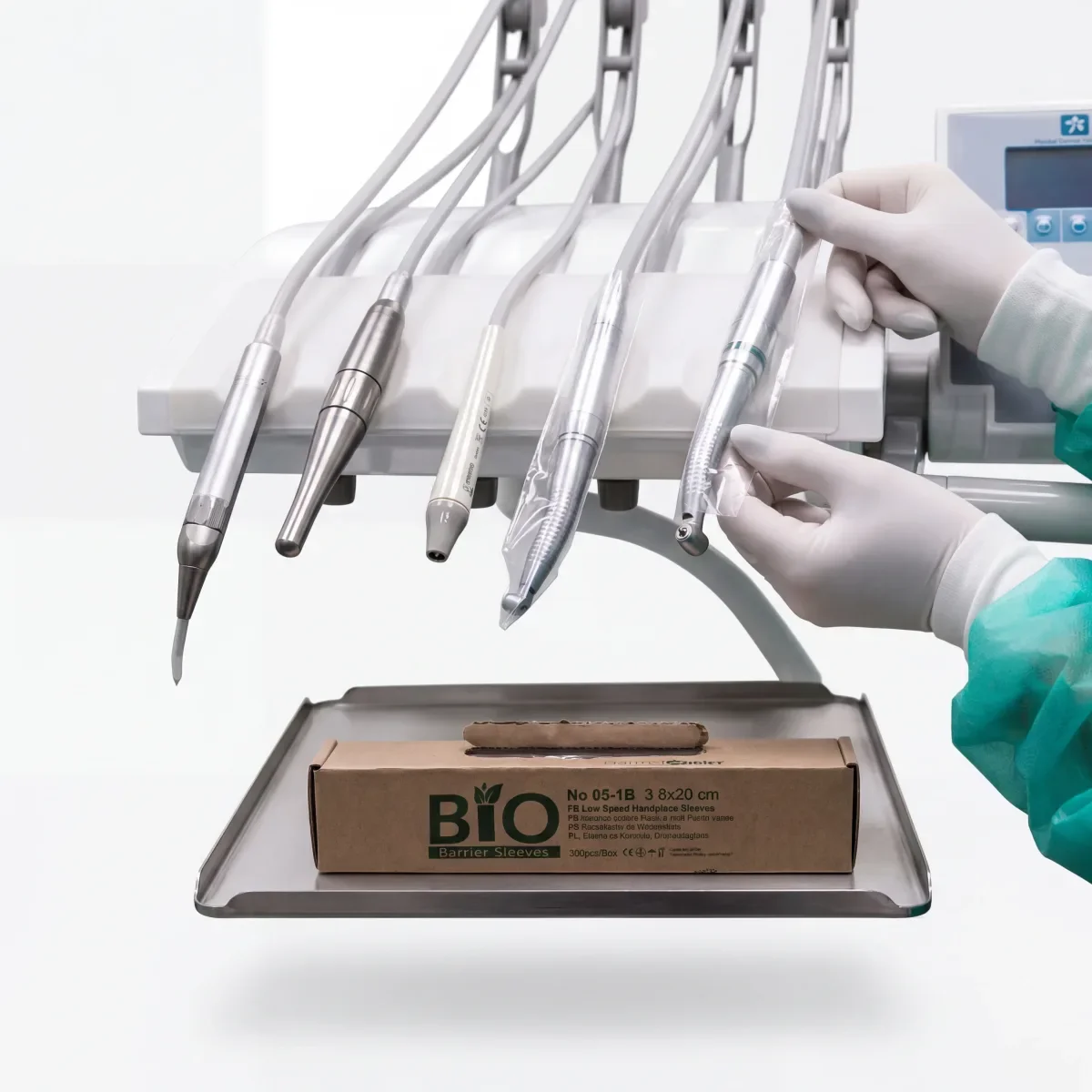
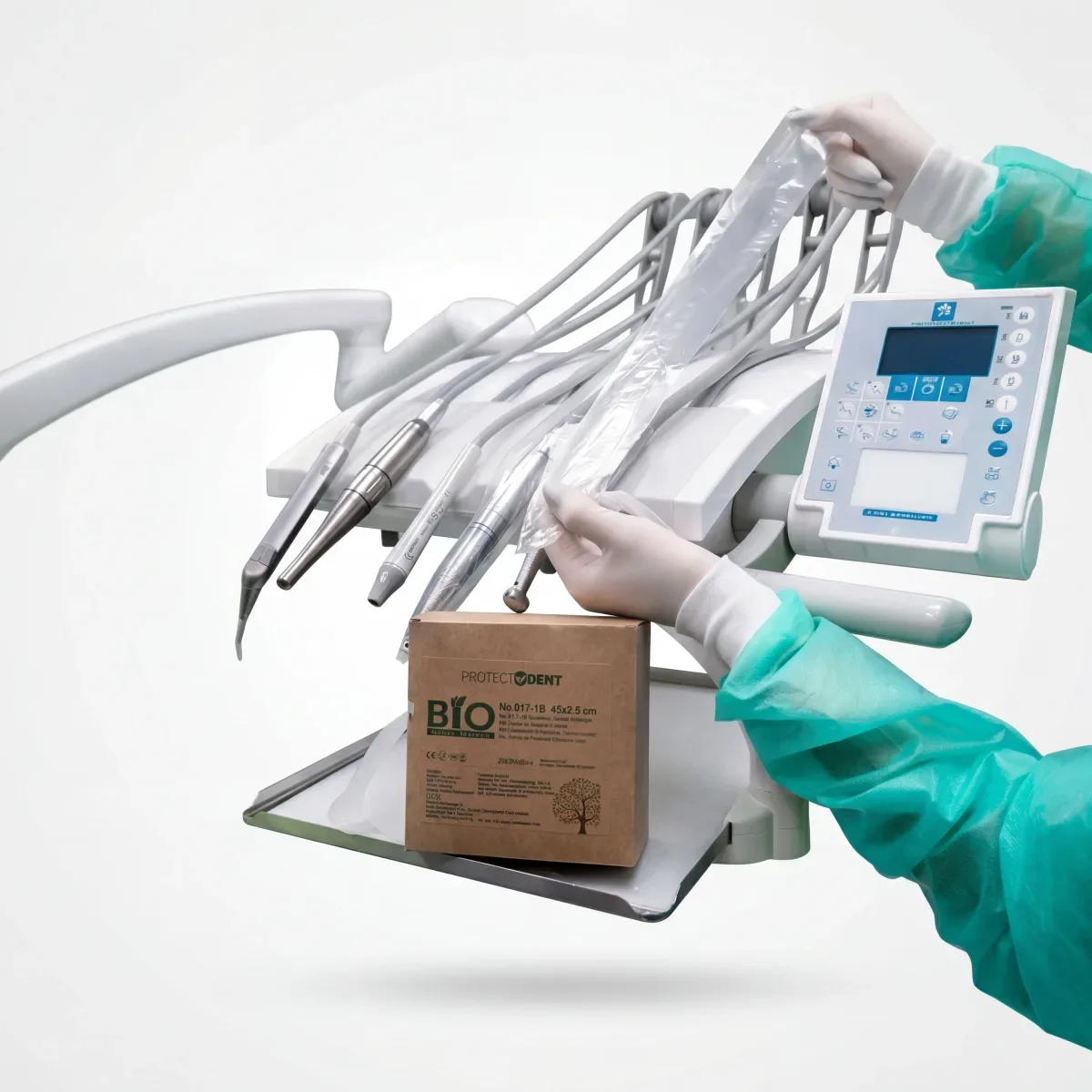
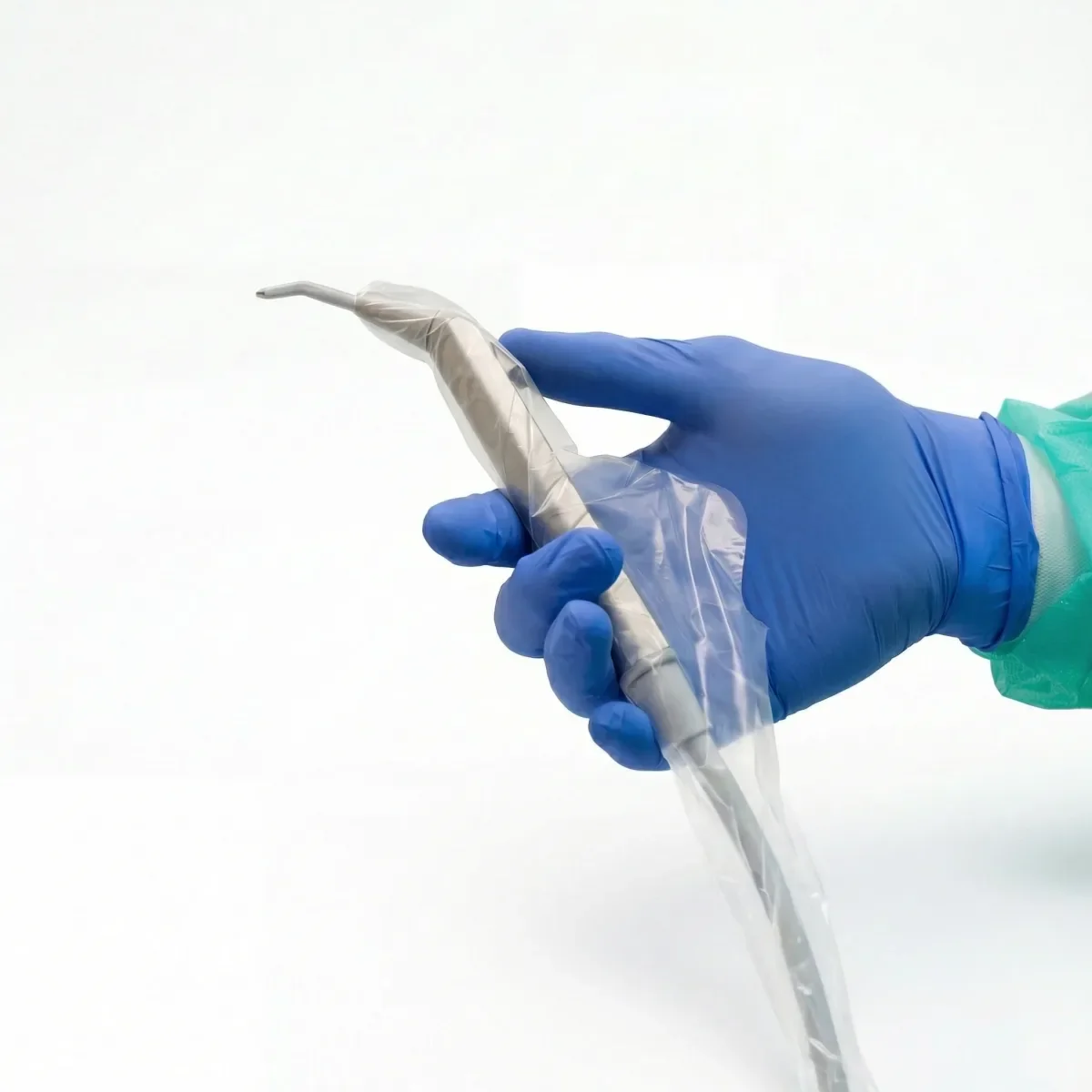
The compressor doesn't touch a patient, but everything downstream of it does. The same compressed-air line that the Tornado — or any dental compressor — supplies is what drives high- and low-speed handpieces and the air side of the air/water syringe at the chair. When a practice reviews its equipment room, replaces a compressor, or adds a soundproof hood, it's a reasonable moment to also check that the barrier protocol at the other end of that same air line is stocked, correctly sized, and actually being used between patients. One conversation is about keeping the air supply running; the other is about what happens to that supply once it reaches the operatory. They're two ends of the same pipe.
What changes Monday morning
- Check the compressor's clearance: dust on the cooling fins or a unit crammed against a wall is worth flagging even without a full replacement.
- Confirm who owns the daily drain-and-pressure check and that it's actually logged, not just assumed.
- Line up the annual filter, dryer, and safety-valve check against the compressor's own maintenance schedule rather than a generic date.
- While you're in the equipment room, glance at the operatory: are handpiece and air/water syringe barriers being restocked on the same cadence as the compressor's own maintenance, or has one of the two quietly slipped?
"The flow design of the air ducting ensures more efficient heat dissipation and protects critical components from heat stress." — Dürr Dental, on the redesigned Tornado compressor
Sources
- NEW Tornado by Dürr Dental Wins German Design Award 2026 — Dürr Dental, 2026-08-31
- Prevent Downtime: Daily Dental Air Compressor Maintenance — FSR, 2026-08-31
- Maintenance for Dental Vacuums and Air Compressors — DentalEZ, 2026-08-31