Kerr's Demi Pro Has a Rotating Tip. Here's What That Means for Your Barrier Sleeve.
Why this matters now
Kerr Dental launched a new cordless curing light, the Demi Pro, on 16 April 2026. The change that matters for your sleeve stock isn't the marketing description — it's the tip. Demi Pro's tip rotates a full circle rather than sitting fixed at one angle, and the unit adds a diagnostic mode that shines light through tooth structure instead of curing resin. Neither is a dramatic change on its own, but together they change when a barrier sleeve gets fitted, not only whether one is used.
What actually changed
Kerr describes Demi Pro as a lightweight, aluminium-bodied unit with a pen-style grip and a "360-degree rotatable, low-profile curing tip." Alongside the new tip, the launch adds:
- An integrated radiometer that checks light output before use
- Tip-mismatch detection, which flags an incorrectly fitted tip
- Four modes: Standard, High Power, Ortho and Diagnostic Transillumination
- An optional transillumination tip, sold separately, for the diagnostic mode
- A stated beam spectrum of roughly 380–515 nm, depending on mode
Kerr's product manager framed the goal as letting clinicians work "at every angle" without trading off optical output. That's a comfort and ergonomics pitch, not an infection-control one — but a tip that rotates into position after the light is already near the mouth is a different fitting problem than a tip that never moves.
What this means in the operatory
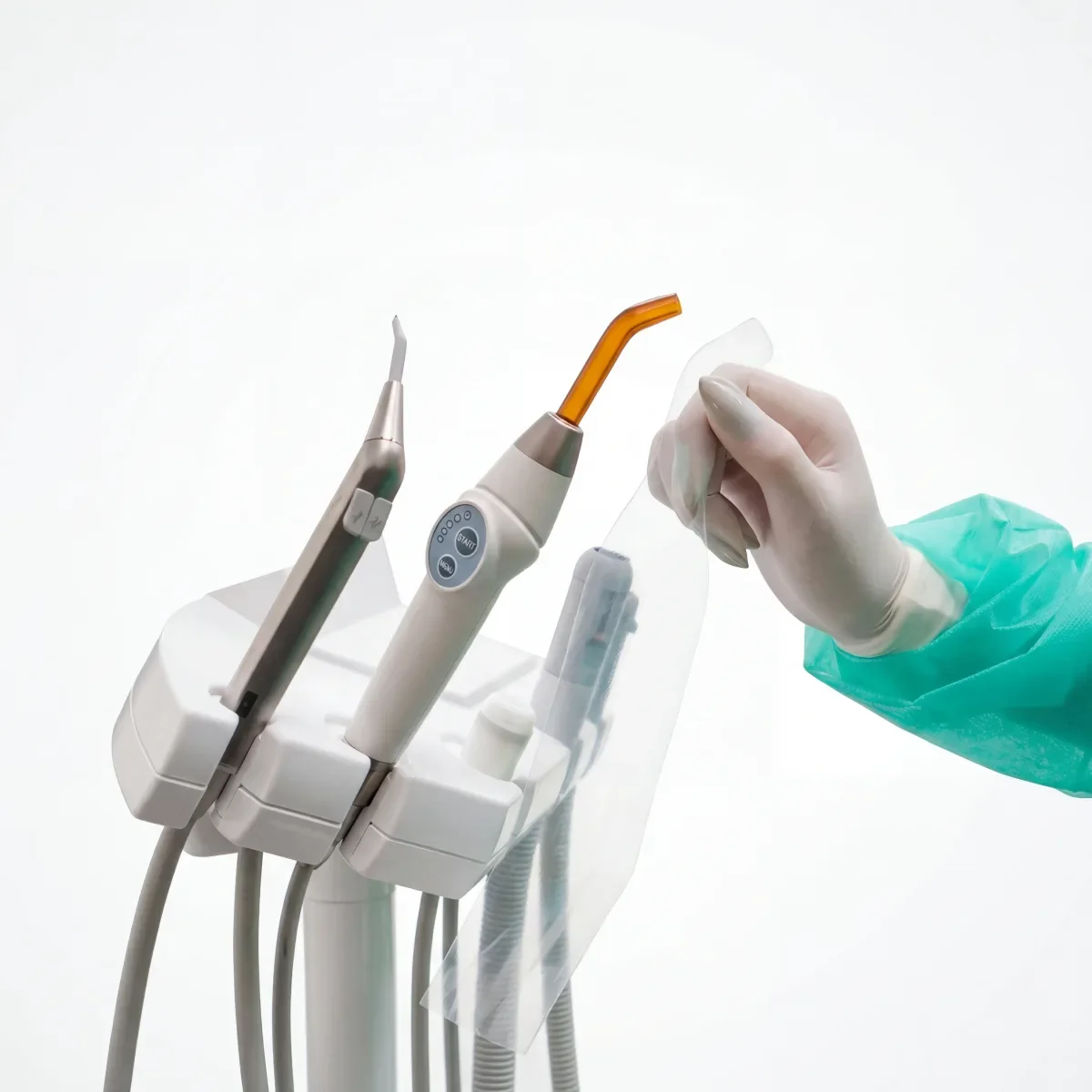
Fit a sleeve before the tip is rotated to its working angle, and the material can twist with it — bunching at the pivot point and thinning across the face of the lens exactly where light needs to pass through cleanly. On a fixed-tip curing light this doesn't come up, because the sleeve goes on once, in one orientation, and stays there for the appointment. On a rotating tip, the order of operations changes: set the angle first, then fit the sleeve.
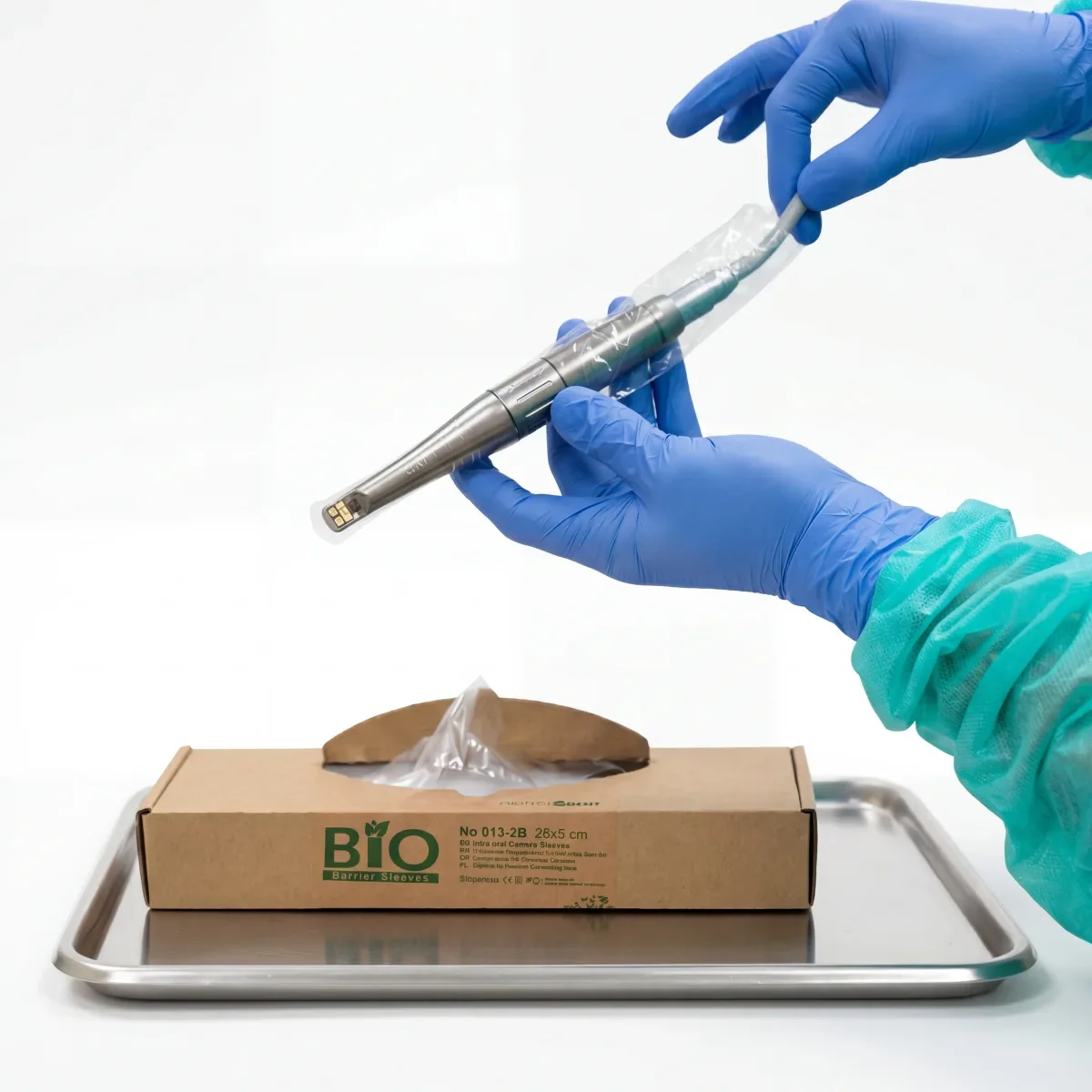
The Diagnostic Transillumination mode raises a separate, unresolved question. A September 2025 study in Brazilian Oral Research measured bacterial contamination on 29 curing light tips before use, immediately after clinical use, and after a 70% ethanol wipe. Turbidity — a sign of microbial growth — appeared in 60.7% of samples before use, rose to 100% after clinical use, and was still present in 57.1% of tips after disinfection. The same study tested whether plastic barrier sleeves weakened the resin composites cured through them, and found they did not measurably reduce flexural strength, concluding that sleeves are a "viable and safer alternative for the prevention of cross-contamination" than disinfection alone.
That finding is about curing performance. Nobody has published data yet on light transmission through a sleeve in transillumination mode specifically — a diagnostic use, not a curing one — so we're not going to guess at a number. If your practice adds the optional transillumination tip, that's a question for the sleeve supplier and for Kerr, not an assumption carried over from curing-mode testing.
What to check
- Ask your sleeve supplier whether their product is listed as compatible with Demi Pro specifically, not "curing lights" generically — the rotating low-profile tip is a new geometry
- Fit the sleeve after the tip is rotated to the angle you'll use, not before
- If you add the transillumination tip, ask both the supplier and Kerr whether transmission in that mode has been tested through a barrier
- Keep disinfecting the handle and grip between patients regardless of the sleeve — the study above disinfected tips that were also uncovered, and a sleeve protects the tip, not the parts of the unit a hand touches directly
Frequently asked questions
What's new about Kerr's Demi Pro curing light?
It has a 360-degree rotatable, low-profile tip, an integrated radiometer, tip-mismatch detection, and four modes including a new Diagnostic Transillumination mode with an optional separate tip. It launched on 16 April 2026.
Does a barrier sleeve weaken the cure or the composite?
A September 2025 study in Brazilian Oral Research found plastic barrier sleeves did not measurably reduce the flexural strength of resin composites cured through them.
Is wiping the tip with ethanol enough without a sleeve?
The same study found microbial growth reached 100% of samples after clinical use, and persisted in 57.1% of tips even after a 70% ethanol wipe — disinfection alone did not eliminate contamination.
When should I fit the sleeve on a rotating-tip light like the Demi Pro?
After the tip is rotated to the angle you'll actually use, not before. Fitting it first can leave the material twisted or thinned at the rotation point.
Will my current curing light sleeve fit the Demi Pro?
Check with your supplier specifically for Demi Pro compatibility. The rotating, low-profile tip is a new geometry, and a generic 'fits most curing lights' claim may not account for it.
Sources
- Kerr Dental Launches Demi(TM) Pro - The Light That Moves With You — Kerr Dental (Newswire), 2026-09-26
- Kerr Dental Launches Demi Pro Curing Light with Extended Battery Life and Ergonomic Design — GeneOnline News, 2026-09-26
- Evaluating microbial load on dental curing lights and the impact of protective barriers on resin composites — Brazilian Oral Research, 2026-09-26